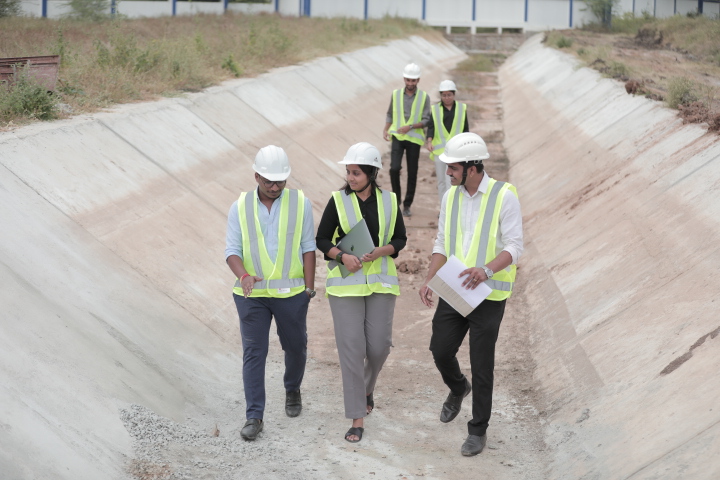
Construction and Real Estate
Still the anchor industry, and probably always will be in India given the sheer volume of building happening at any given time.
Large construction firms, real estate developers, and EPC contractors hire project managers to handle planning, scheduling, cost control, and site coordination on projects ranging from residential towers to industrial parks. A PGDM with specialization in Advanced Project Management with exposure to tools like Primavera and MS Project gives graduates a real edge here, since most firms expect candidates to walk in already familiar with scheduling software rather than learning it on the job.
Roles in this space include project planner, site administrator, contracts manager, and project controls specialist. Procurement and contract management roles sit close by, often filled by the same talent pool.
Infrastructure and Public-Private Partnerships
This is where project management gets genuinely complex, and genuinely well-paying.
Highways, metro systems, airports, smart cities, these projects run on public-private partnership structures that demand a different skill set than a straightforward construction job. Project finance, stakeholder management across government and private partners, and risk management at a scale most single-building projects never approach.
Government bodies, infrastructure development authorities, and PPP consultancies are actively recruiting for this. A project management course that covers public-private partnership structures and infrastructure project management specifically, rather than generically, prepares graduates for roles that a standard MBA simply doesn't touch.
Smart city projects deserve a specific mention. India's smart city push has created a genuine new category of project management roles, blending urban planning with traditional project delivery skills.
Energy, Oil and Gas
Renewable energy alone is hiring at a pace that's hard to overstate right now.
Solar and wind project developers need project managers who understand both the engineering side and the financial structuring that renewable energy projects typically require. Oil and gas companies, meanwhile, run massive capital project such as refineries, pipelines, offshore platforms, that need project managers fluent in risk, safety compliance, and long-timeline budget control.
Graduates from a strong diploma in project management programme, particularly ones with coursework in renewable energy project management and oil and gas project fundamentals, find this sector receptive. Companies in this space pay well for the specific technical-plus-managerial combination that generalist MBAs rarely produce.
IT and Software Development
Not where most people expect project management careers to lead, but the demand here has grown considerably.
Software companies run projects with their own logic: sprints instead of construction milestones, agile frameworks instead of Gantt charts, cross-functional engineering teams instead of site crews. Still, the underlying discipline transfers. Stakeholder communication, risk tracking, resource allocation, deadline management, all core project management skills regardless of whether the deliverable is a building or a mobile app.
IT firms increasingly hire dedicated project managers rather than promoting senior engineers into the role by default. A project management course covering project analytics and enterprise resource planning gives candidates a real foothold here, even without a software engineering background.
MEP and Specialised Engineering Projects
A narrower category, but one that pays disproportionately well for the right skill set.
Mechanical, Electrical, and Plumbing project management is its own specialisation within the broader field, and demand for it has grown alongside India's construction boom. Hospitals, data centers, large commercial complexes, all of these need MEP project managers who understand the technical systems well enough to coordinate between multiple specialised contractors.
Graduates with focused coursework in MEP project management, building information modelling, and digital transformation in projects are positioned well here. This is one of the diploma project management courses categories where the technical depth genuinely matters more than general management theory.
Healthcare, Education, and Social Sector Projects
Less obvious, growing steadily.
Hospital construction, educational campus development, rural infrastructure, and community service projects all run as formal projects now, with their own budgets, timelines, and stakeholder complexity. Government bodies and large NGOs increasingly bring in trained project managers rather than relying on generalist administrators for this work.
It's a smaller slice of overall hiring compared to construction or infrastructure, but the project management career opportunities here are real, and competition for them tends to be lighter since fewer graduates target this sector specifically.
Why This Spread Matters for Job Seekers
A PG diploma in project management isn't a single-industry credential anymore, and that's actually the biggest advantage of choosing this path over a narrower specialisation. Someone graduating today has genuine options across construction, energy, IT, infrastructure, and even healthcare, without needing six different degrees to get there.
The common thread across all these industries is the same core skill set: planning, risk management, stakeholder communication, and budget control. What changes is the context. NICMAR's PGDM APM programme, for instance, builds coursework spanning renewable energy projects, smart cities, oil and gas, MEP systems, and software development project management into a single curriculum, which is exactly why graduates end up scattered across such different sectors rather than funneled into one.
Over 200 companies visit NICMAR's campus for placements annually. That number alone tells you the industry spread isn't theoretical.